 Cape Town City Guide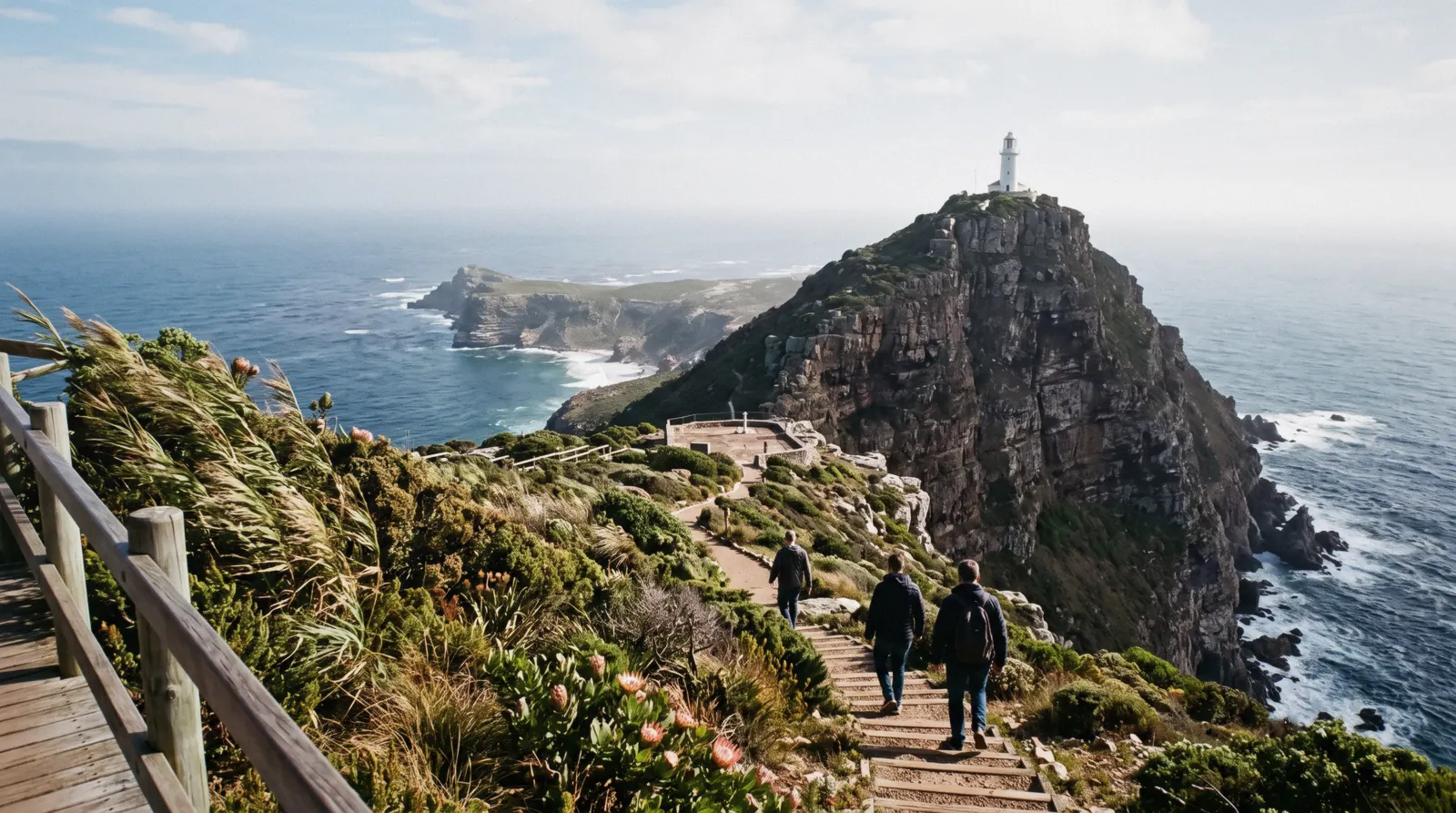
Cape Point & the Cape of Good Hope
Cape Point is the cliff-top tip of the Cape Peninsula, an hour's drive south of the city, and the Cape of Good Hope is the low rocky headland fifteen minutes away inside the same reserve — one gate, one fee, two famous signboards. This page covers the gate rates, the seasonal hours, the Flying Dutchman funicular, the baboon rules and the day tours that come here; the penguins on the same route live on the Boulders Beach page, and the toll road most tours use to get here has its own Chapman's Peak Drive page. The rest of the city starts from what to do in Cape Town.
Quick answer Gate fee, hours, the two signs, which tours include entry
Cape Point and the Cape of Good Hope sit inside one reserve with one gate: international visitors pay $32.00 (R515) per adult and $15.53 (R250) per child, South Africans R110/R55, rates published to 31 October 2026. Gates open 06:00–18:00 October to March and 07:00–17:00 April to September, and payment is cards only — the gate is cash-free.
Key takeaways
- Almost every day tour EXCLUDES the gate fee — the 10-hour Gray Line loop tells you to budget roughly R900–1,000 in park fees on top; only specific options like the City Sightseeing full package build the reserve fee in
- The Flying Dutchman funicular to the old lighthouse costs $7.14 (R115) return and saves a steep 15-minute climb; the walk down via the steps is the better half anyway
- The same road brings you past the penguins — check the Boulders Beach page for its separate R245 gate — and the scenic route in runs over the toll road on the Chapman's Peak Drive page, which closes for rockfall
Key facts
Opening hours
| October–March | 06:00–18:00 |
|---|---|
| April–September | 07:00–17:00 |
Closed None stated — open daily; exit by sunset
Admission
- Adult
- $32.00 (R515) international; SADC $13.98 (R225); South African $6.83 (R110)
- Reduced
- Child 2–12: $15.53 (R250) international, R55 South African — ID required for SA/SADC rates
- Free
- Under 2; funicular is extra: $7.14 (R115) return adult, $3.73 (R60) child 6–16 and pensioners
Planning it
- Time needed
- Not stated officially; our routing: 2 hours for the funicular and both signs, 3–4 hours with Dias Beach and a walk
- Address
- Cape Point Nature Reserve, Plateau Road (M65), Cape Peninsula — 60 km from the city centre
The gate fee and the four main day-tour formats, priced from capepoint.co.za and GetYourGuide, read in Q3 2026. Watch the Includes column: the reserve fee rides on top of almost every tour price.
Are you paying for entry, or for the driver who does the 120 km loop? The gate charges $32.00 (R515); everything below it is transport and company.
| Option | Price | Includes | Park fees | Book |
|---|---|---|---|---|
| Official gate rate (self-drive)Anyone with a hire car — the cheapest way in, and the only one that sets its own pace | $32.00 (R515) adult / $15.53 (R250) child | Reserve entry only; funicular R115 extra | This IS the park fee — cards only, no cash | Official site |
| Full-day Cape Point + Boulders, minivanThe standard full peninsula day, and cheaper than the two gates you would pay alone | From $40.04 | Transport, guide, hotel pickup, 10 h | Excluded — R515 gate + R245 Boulders on the day | Check Availability |
| Gray Line peninsula loop, small groupA smaller vehicle and a guide who talks, for about $13 more | From $52.95 | New Sprinter, guide, pickup, 10 h | Excluded — budget about R900–1,000 per adult | Check Availability |
| Table Mountain + penguins + Cape PointFitting Table Mountain in as well, if the wind cooperates | From $59.18 | Three big sights in one 10-h day | Excluded — roughly R1,365 if you take everything | Check Availability |
| Private full-day peninsula tourFour people or a family who want the day on their own clock | From $155.75 per person | Private vehicle, your own schedule, 8 h | Excluded — paid at each gate | Check Availability |
One number decides the real cost: the R515 international gate fee. A $40 tour becomes roughly $87 once you add Cape Point and Boulders entries, which is still cheaper than hiring a car for the day — but compare like with like. The City Sightseeing coach option is the exception that can include the reserve fee; check which ticket variant you pick at checkout.
Cape Point day tours compared
Every card links to the operator's own page with live dates. All prices are USD as listed, and every one excludes the R515 gate fee unless the card says otherwise.
 from $40.04
From Cape Town: Cape Point & Boulders Beach Full-Day Tour
The budget full-day peninsula tour: 10 hours, hotel pickup and an air-conditioned minivan for around $40 — because every entry fee (Boulders R245, Cape of Good Hope R515) is paid separately on the day.
Check Availability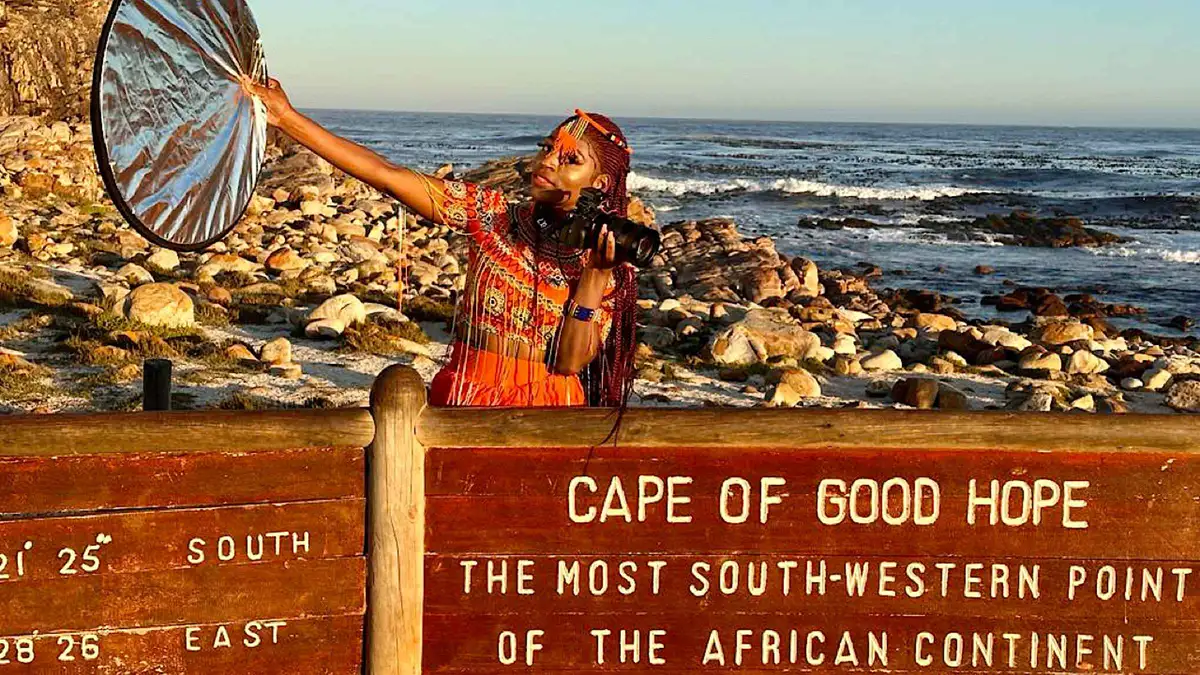 from $52.95
Cape Town: Cape of Good Hope & Penguins Day Tour with Pickup
10-hour Cape Peninsula loop — Cape of Good Hope, Boulders penguins, Chapman's Peak — in a new Sprinter with accredited guide. Every park fee is extra: budget about R900-1,000 per adult on top, cash or card on the day.
Check Availability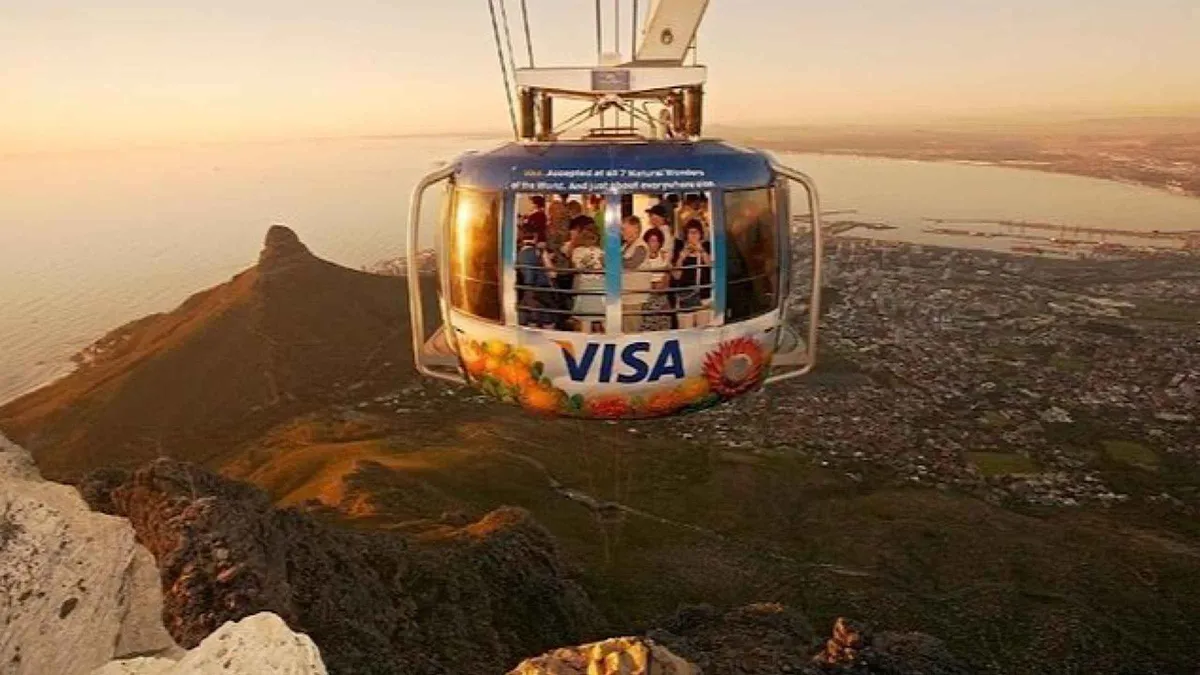 from $59.18
Cape Town Tour: Table Mountain, Penguins & Cape Point + Pickup
The three-big-sights day: Table Mountain, Boulders penguins and Cape Point in 10 hours. All entrance fees are extra (roughly R1,365 adult if you take everything) — the operator sends a ticket-purchase link the day before.
Check Availability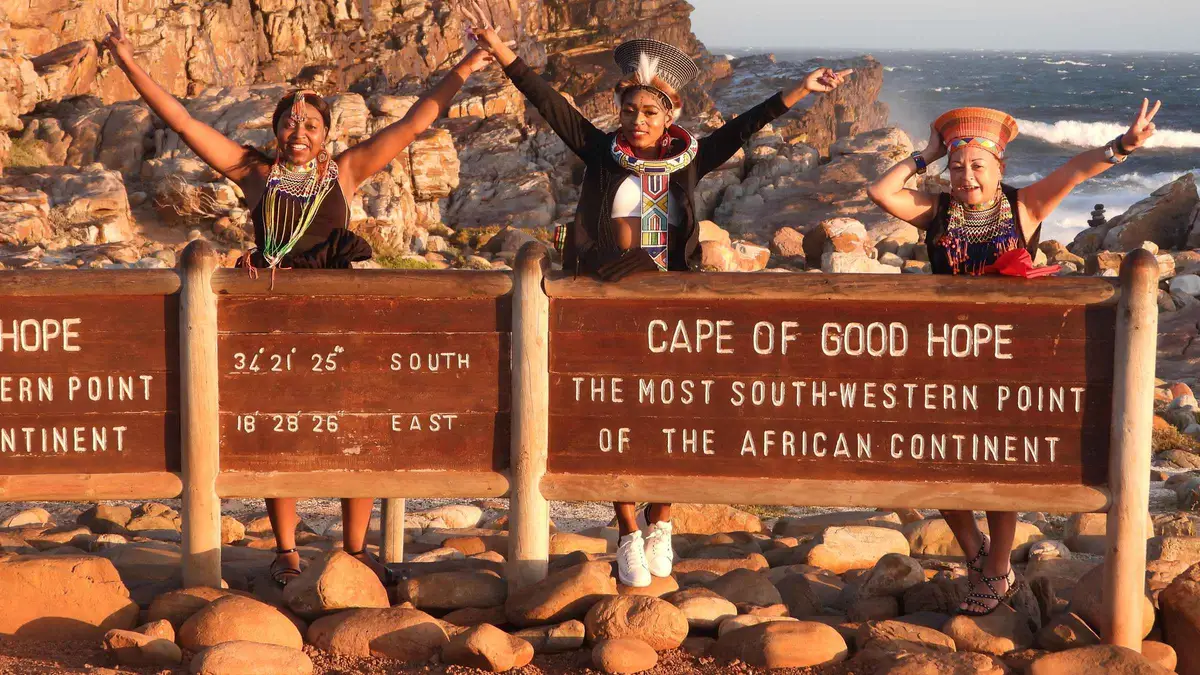 from $155.75
Cape Town: Private Full-Day Cape of Good Hope Tour
The private version of the peninsula day: your own vehicle, guide and schedule for 8 hours at $156 per person. Park fees still excluded — the shared Gray Line tour covers the same route for a third of the price.
Check Availability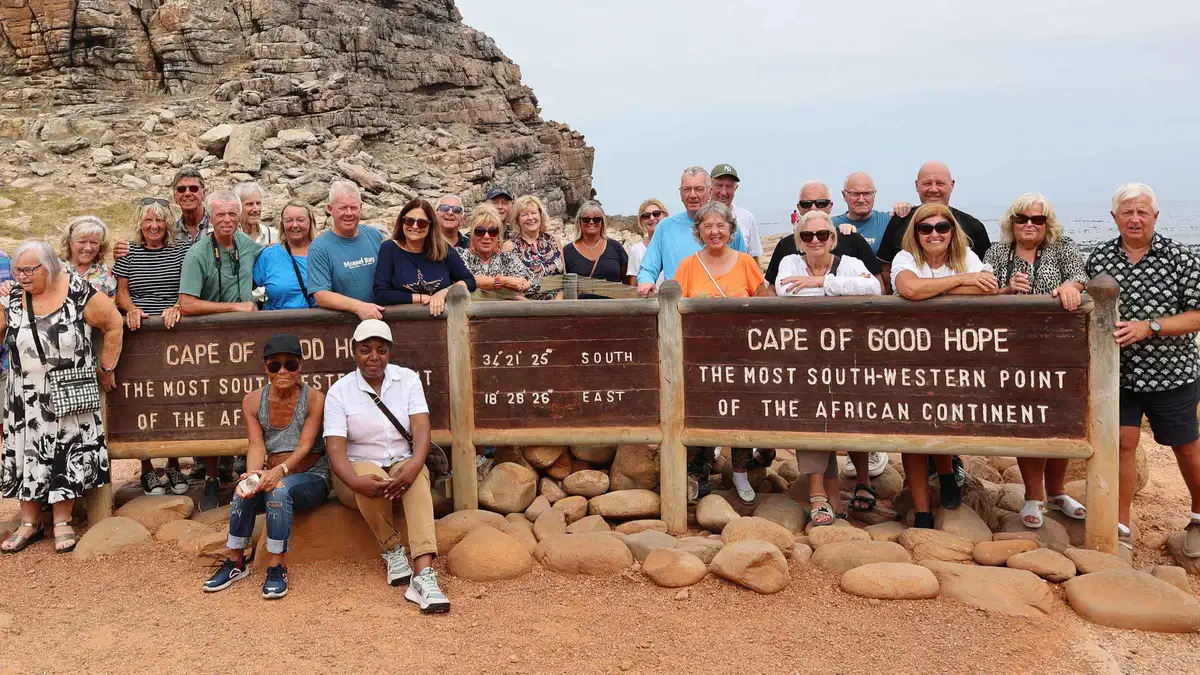 from $40
From Cape Town: Cape Point and Boulders Beach Half-Day Tour
Cape Point and Boulders compressed into 5 hours with hotel pickup — the half-day option when a 10-hour loop is too much. Both park entries (R245 + R515 adult) are paid on the day, not in the price.
Check Availability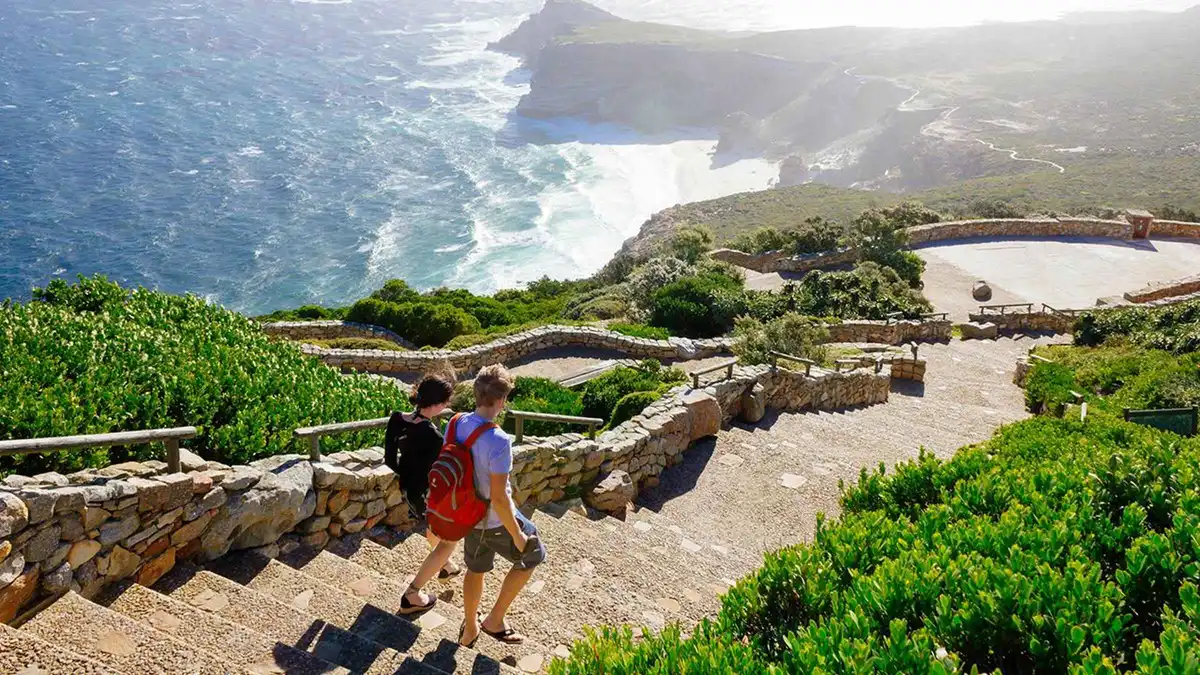 from $31
From Cape Town: Cape Point and Boulders Beach Full-Day Tour
Coach-based Cape Point day from $31 in a double-decker with Wi-Fi. Check which option you pick: only the dearer one includes the R515 reserve fee, and Boulders entry plus funicular stay pay-on-the-day.
Check AvailabilityPrices, ratings and details are the platform's own. Dollar figures are the listed prices. The platform bills in your account's currency.
One reserve, two signs: Cape Point vs the Cape of Good Hope
The most common confusion on the whole peninsula is which cape you are actually visiting. The answer is both — they are two corners of the same headland, a 10–15 minute drive or a 45-minute cliff walk apart, covered by the same gate fee.
Cape Point: the high cliffs, the funicular and the lighthouses
Cape Point is the dramatic one: cliffs dropping a couple of hundred metres straight into the sea, the funicular station, the restaurant and the two lighthouses. This is where the main car park sits, where every tour bus parks and where the classic photographs are taken from the old lighthouse platform. If you have time for only one of the two stops, this is it — the views run back along the whole False Bay coast on a clear day.
The Cape of Good Hope: the sign at sea level
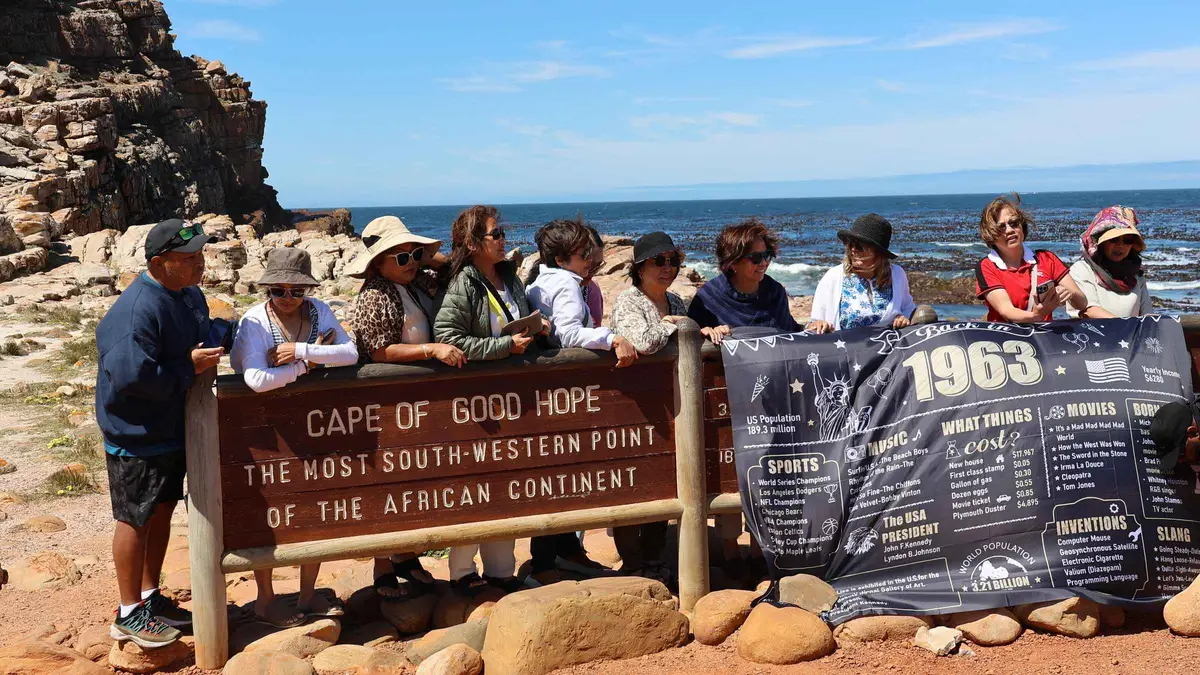
The Cape of Good Hope is the low, rocky point on the Atlantic side — the south-western-most point of the African continent, which is what its famous wooden signboard says. There is no funicular and no café here, just the sign, the waves and usually a queue of people waiting to photograph each other in front of it. Historically this is the cape Dias rounded in 1488 and the name every sailing route carried; geographically it is the less spectacular of the two stops.
Drive between the two points in about ten minutes, or take the cliff path (roughly 45 minutes each way) past Dias Beach.
Which sign first?
Do Cape Point first, while your legs are fresh for the lighthouse climb, then drive down to the Cape of Good Hope sign on the way out — the light on the Atlantic side is better in the afternoon anyway. Tours run it in both orders; on a private tour you can ask for the reverse to dodge the convoy.
Gate fees: dual pricing, validity and the cash-free rule
SANParks manages the gate and prints three rates, and the difference is not small: an international adult pays $32.00 (R515) and a child aged 2–12 pays $15.53 (R250), while a South African adult pays R110 and a child R55 with ID; SADC nationals sit in the middle at R225/R115 with a passport. The published tariffs run 1 November 2025 to 31 October 2026 — price increases land every year on 1 November, so figures you read in older blogs are usually one or two cycles stale.
The gate takes cards only. SANParks gates across the peninsula are cash-free, and there is no online timed ticket to buy in advance for Cape Point — you simply pay when you arrive, which also means there is nothing to sell out.
One warning that saves an argument at the gate: a tour voucher is not an entry ticket. Nearly every day tour sold online excludes the park fees, and the operators say so in their small print — the Gray Line loop tells guests to budget roughly R900–1,000 for all the day's gates and extras, and the budget minivan tour collects the R515 at the gate by card or cash on the day.
- International: $32.00 (R515) adult / $15.53 (R250) child 2–12
- SADC (passport): R225 adult / R115 child
- South African (ID): R110 adult / R55 child
- Cards only at the gate; the rate year runs to 31 October 2026
The Flying Dutchman funicular and the two lighthouses
R115 return, or a steep 15-minute climb
From the car park to the old lighthouse platform is a paved but steep walk of about fifteen minutes. The Flying Dutchman funicular does the same climb in three; the fares below come from capepoint.co.za, the reserve concessionaire's own tariff page. Our routing: ride up, walk down — the descent is easy and the steps give you the photographs the funicular window does not.
The funicular runs 09:00–17:30 in summer and 09:00–17:00 in winter, inside the gate hours; its 2026 maintenance shutdown ran 20 July to 31 August and is over, but check the official site before a winter visit.
| Ticket | Adult | Child 6–16 / pensioner 60+ |
|---|---|---|
| Funicular return | $7.14 (R115) | $3.73 (R60) |
| Funicular one-way | $6.21 (R100) | $3.23 (R52) |
| Walking (15 min up the paved path) | Free | Free |
Why there are two lighthouses
The old lighthouse of 1859 stands at the very top of the peak — which turned out to be the problem. It sat so high that the Cape's fog and low cloud regularly hid the light exactly when ships needed it, and after the Portuguese liner Lusitania struck Bellows Rock below the point in 1911, a new lighthouse was built lower on the cliffs at Dias Point, completed in 1919. That newer light still works; the 1859 tower is the viewpoint everyone rides the funicular to.
From the platform a walkway continues towards the new lighthouse lookout — narrow, windy and the best short walk in the reserve.
Hours, seasons and the wind
The reserve keeps two seasonal timetables, published on capepoint.co.za and compared in the table below — the rule of thumb is that everything shifts an hour earlier in winter.
Plan around the wind, not the rain. In summer the south-easter — the same wind Capetonians call the Cape Doctor — blows hardest of the year; ERA5 climate data for Cape Town shows south-east winds dominate 51–58% of days from November to March, and this headland is one of the most exposed places on the peninsula. A strong south-easter day means sandblasted legs at the Cape of Good Hope sign and a battle to stand upright on the lighthouse walkway. Mornings are usually calmer than afternoons.
In winter (June to August) the reserve is green, the light is cleaner between fronts, and the crowds thin out — and July to November adds the chance of southern right whales in False Bay on the drive down. The trade-off is rain: June averages 94 mm in the city against 13 mm in January.
| Facility | October–March | April–September |
|---|---|---|
| Reserve gates | 06:00–18:00 (exit by sunset) | 07:00–17:00 |
| Flying Dutchman funicular | 09:00–17:30 | 09:00–17:00 |
| Two Oceans Restaurant | 11:00–17:30 | 11:00–17:00 |
Baboon rules: keep the windows up and the food hidden
The chacma baboon troops of the southern peninsula are the one genuinely misbehaving wildlife you will meet, and the rules exist because people fed them. SANParks' standing advice, repeated on boards through the reserve, comes down to this: never feed a baboon (it carries a fine and eventually a death sentence for the animal), keep car windows closed and doors locked in the car parks, don't carry visible food or plastic bags — they have learned exactly what a shopping bag means — and don't try to pull food back from a baboon that has grabbed it. Keep small children close at the viewpoints.
In practice: eat inside at the restaurant or inside your car with the doors shut, not at an open picnic beside the car park. The troops work the Cape Point parking area and the gate queue most actively in the middle of the day when the tour buses unpack their snacks. Treat them like the wild animals they are and the encounter stays a photo opportunity; the tour guides deal with this daily and will tell you the same before you get out of the van.
- Never feed baboons — it's an offence and it trains the raids
- Windows up, doors locked, food and bags out of sight in cars
- No visible snacks or plastic bags while walking
- If one grabs your food, let it go — never pull back
Getting there: the loop drive and the Chapman's Peak question
The reserve gate is about 60 km from the city centre — allow 75 to 90 minutes each way without stops. There is no public transport to Cape Point; you drive, or you take a tour. The classic route is a loop: down the Atlantic side through Hout Bay and over Chapman's Peak Drive (a toll road, R68 per car), then back up the False Bay side through Simon's Town — passing Boulders Beach — and Kalk Bay. Driven that way, the peninsula is a full day, not an errand.
One live caveat: Chapman's Peak closes for rockfall and weather, and it was closed at the time of our visit. When it is shut, the detour runs inland over Ou Kaapse Weg to the False Bay side and adds about twenty minutes; every tour operator reroutes the same way. Check the status banner on chapmanspeakdrive.co.za before committing to the Atlantic-side route — the Chapman's Peak page explains the toll and the closures.
Inside the reserve, distances are bigger than people expect: the gate to the Cape Point car park is another 13 km of fynbos, ostriches and the odd bontebok or eland. Fuel up before the peninsula; there is no petrol station inside the reserve. Driven as a full day like this, the peninsula is exactly the kind of route covered by guided tours in Cape Town, so browsing the Cape Town tours page is a good next step before you commit to driving it yourself.
Walks, Dias Beach and the two-oceans question
Three walks worth the time
The lighthouse walkway from the funicular top station towards the Dias Point lookout is the essential one — twenty minutes return, fenced, spectacular. The cliff path between Cape Point and the Cape of Good Hope takes about 45 minutes each way and turns the two-sign errand into an actual coastal hike; steep wooden stairs drop halfway along to Dias Beach, a wild, swimming-unfriendly wedge of sand between the cliffs that is many visitors' favourite photograph of the day. Walk it out-and-back and have the driver — or your patient co-traveller — move the car between the two car parks.
No, the two oceans don't meet here
The Atlantic and Indian Oceans officially meet at Cape Agulhas, about 150 km further east — the actual southernmost tip of Africa, covered on our Cape Agulhas page. Cape Point sells a better story from higher cliffs, and the warm Agulhas and cold Benguela currents do mix unevenly along this whole coast, which is where the legend comes from. The reserve itself no longer claims the meeting point; the sign at the Cape of Good Hope says 'south-western-most point of the African continent', and that one is true.
Cape Point map: gate, signs, funicular and Dias Beach
The reserve entrance, the two signboards, the funicular base station and the beach between them — distances inside the reserve are drives, not strolls.
On the same peninsula day
Drive times are our estimates from the reserve gate; every tour below strings the same three stops together.
Boulders Beach
The African penguin colony at Simon's Town, with its own gate and its own R245 international fee. Boulders Beach is the natural second stop on the way back up the False Bay side.
25 min driveChapman's Peak Drive
The 114-curve toll road between Noordhoek and Hout Bay most tours use for the Atlantic-side leg. Chapman's Peak Drive closes for rockfall — check the live status first.
40 min driveKalk Bay
Harbour village on the False Bay side with fish straight off the boats and an antique row. Kalk Bay is the best late-lunch stop of the loop.
45 min driveCape Point questions
How much is the entrance fee to Cape Point?
International visitors pay $32.00 (R515) per adult and $15.53 (R250) per child aged 2–12 at the gate; South Africans pay R110/R55 with ID and SADC nationals R225/R115. Rates are published to 31 October 2026 and the gate takes cards only. The fee covers the whole reserve including the Cape of Good Hope — but the day tours exclude it, so budget it on top of any tour price.
Is Cape Point where the two oceans meet?
Officially no — the Atlantic and Indian Oceans meet at Cape Agulhas, about 150 km east, the true southernmost point of Africa. Cape Point's own signage claims only what is true: the Cape of Good Hope is the south-western-most point of the continent. Our Cape Agulhas page covers the real meeting point.
Are Cape Point and the Cape of Good Hope the same place?
They are two corners of one headland inside the same reserve, one gate fee apart from nothing: Cape Point has the cliffs, funicular and lighthouses, the Cape of Good Hope is the sea-level sign 10–15 minutes' drive away, or a 45-minute cliff walk past Dias Beach. Every full-day tour visits both.
How much is the Flying Dutchman funicular?
A return trip is $7.14 (R115) per adult and $3.73 (R60) for children 6–16 and pensioners; one-way R100/R52. It runs 09:00–17:30 in summer, 09:00–17:00 in winter, and replaces a steep 15-minute climb to the old lighthouse. Ride up, walk down — the steps have the better views.
Do Cape Point tours include the entrance fee?
Almost never — assume the R515 gate fee is on top of the tour price unless the listing says otherwise. The Gray Line loop tells guests to budget roughly R900–1,000 for the day's park fees and extras, and only certain variants of the City Sightseeing tour build the reserve fee in. Read the Includes line on every card before comparing prices.
How long do you need at Cape Point?
The reserve states no visit length. Our routing: two hours covers the funicular, the lighthouse walkway and the Cape of Good Hope sign; add an hour or two for the cliff path and Dias Beach. With the 60 km drive each way — plus Boulders Beach on the way back — the peninsula is a full day out of Cape Town.
Are the baboons at Cape Point dangerous?
They are wild animals that have learned to raid, not attack — the incidents are almost all about food. Follow the SANParks rules: never feed them, keep car windows up and food out of sight, carry no visible snacks or plastic bags, and let go of anything a baboon grabs. Do that and the troop at the car park is a highlight, not a problem.
Where Cape Point fits in a Cape Town trip
Give it a full day and make it the peninsula day: down the Atlantic side, Cape Point and the Cape of Good Hope before the convoy arrives at midday, penguins at Boulders Beach mid-afternoon, then coffee in Kalk Bay on the way home. Self-driving buys you the 06:00 summer gate and an empty lighthouse platform; a tour buys you a guide, a Sprinter and zero navigation on the day Chapman's Peak decides to close. The three-day itinerary runs this exact day as day two, and the full attractions list ranks it against everything else in the city.
Cape Point on film: the cliffs, the funicular, the drive
Three videos that show what the reserve actually looks like — the scale of the cliffs, the funicular ride and how the day trip flows. Watch one and the two-signs geography explains itself.
5 Things to do at Cape Point: A Guide to Adventure
A quick tour of the reserve's five main stops, from the funicular to the Cape of Good Hope sign.
Video: Beautiful News TravelCape Point, Cape Town! Ep 454
A full visit filmed on the ground — car park, lighthouse climb and the cliff views along the walkway.
Video: DustBugs TravelCape Point Drive Nature Reserve South Africa
The drive through the reserve itself — useful for judging distances between the gate, the signs and the beaches.
Video: Emma & OferVideos load from YouTube only when you press play.
Prices, hours and terms are set by the venue or operator and confirmed at checkout.
We may earn a commission if you book through one of our links, at no extra cost to you. Full affiliate disclosure